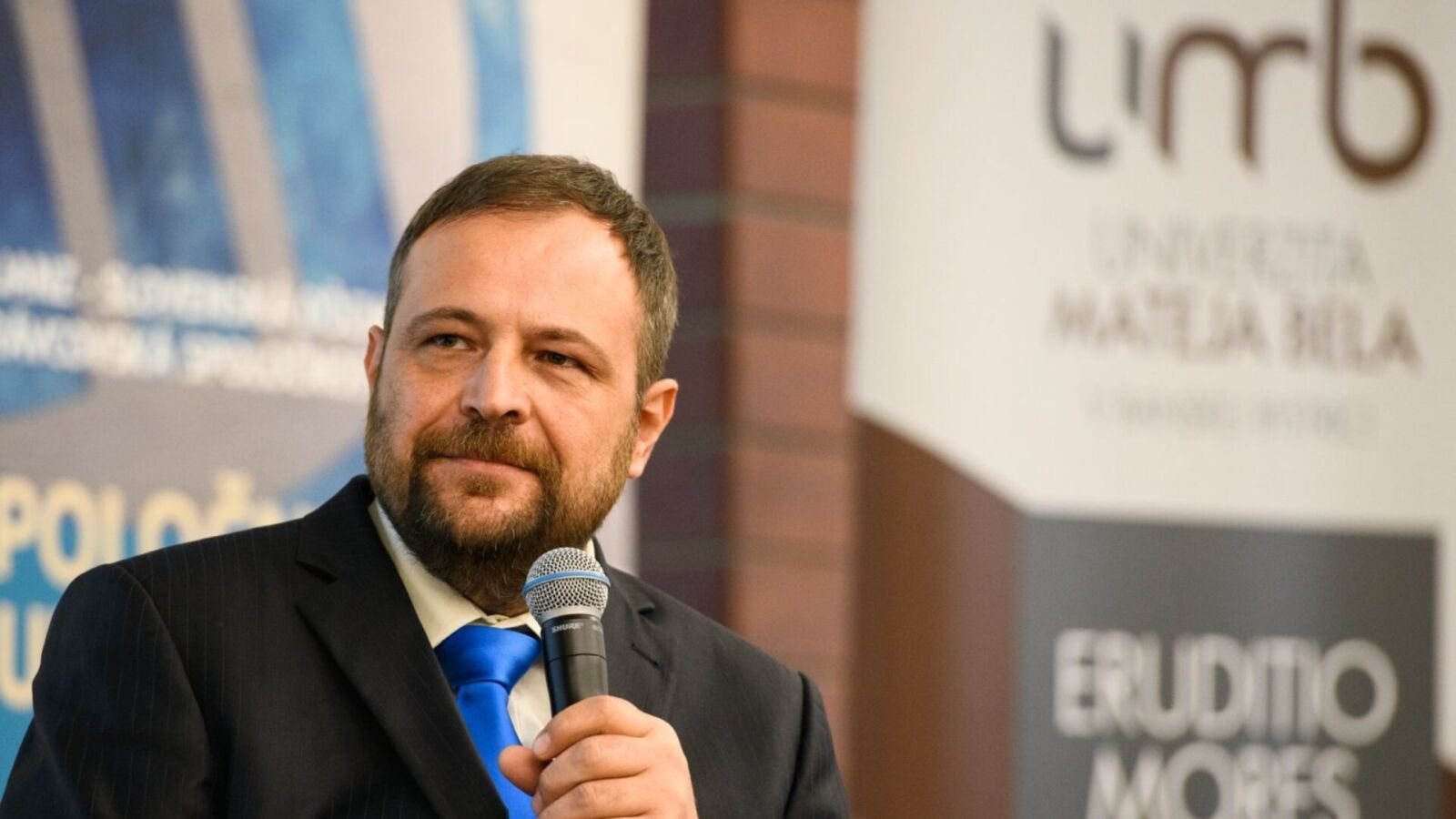
Most companies believe they are digital. They have scanned documents, implemented systems, moved to the cloud. Radovan Brečka from Teseron thinks otherwise—and he has compelling reasons. As a graduate of theoretical computer science, the architect of the eKolok system with transactions exceeding three billion euros, and the author of the Hyperprogramming concept, he knows better than anyone where true digitalisation ends and where only expensive digital waste begins.
In this interview, he speaks candidly about the software barrier that is holding companies back today in much the same way that costly mainframes once did—and about how to overcome it.
We discussed Hyperprogramming, what really lies behind the term “digital waste”, the eKolok system with transactions exceeding three billion euros, and what advice he would give to young visionaries who want to change the world. The result? An interview that made us rethink our established ideas about what digitalisation truly means.

The Software Barrier: A Problem That Is Not Discussed Enough
We began at the core of his research. Hyperprogramming sounds like a term from a science-fiction novel, but behind it is a very specific and practical philosophy.
“In the late 1980s, there was a hardware barrier in the computerisation of companies. Mainframes were expensive, and only a few large companies could afford them,” Brečka explains. “Then the arrival of affordable PCs eliminated this barrier, and most companies implemented back-office information systems for accounting, inventory, payroll…”
The problem is that history repeats itself—only with a different opponent.
“Today, in traditional programming, we have a software barrier that prevents effective digitalisation of processes on top of these back-office systems. Implementing business processes is demanding and expensive, and full digitalisation is once again something only a few large companies can afford.”
And even for those large companies, it does not bring real freedom. “Even in these large companies, there is a problem with the flexibility of processes implemented in this way,” he adds.
Hyperprogramming is meant to be the answer. Its goal is to remove the software barrier and enable companies not only to digitalise processes, but also to evaluate them effectively and respond to market impulses through planning. In short, to bring order where chaos prevails.
Three Billion Euros and 450 Systems: A Lesson from eGovernment
If you want to find out whether someone truly understands systems integration, ask them about the most demanding thing they have ever done. In Brečka’s case, the answer is clear.
He led the implementation of the eKolok system, a platform through which transactions totalling more than three billion euros have passed. We asked him what his greatest professional challenge was personally.
“Integrating 450 external information systems in the Slovak eGovernment environment,” he replied without hesitation.
A short sentence. A huge reality. Anyone who has ever worked on integrating even just two systems knows what we mean. Four hundred and fifty systems, each with its own logic, its own language, its own exceptions. This is not just programming—it is architecture, communication, and crisis management all in one.
Digital Waste: When a PDF Replaces Paper but Nothing Changes
This brings us to the topic that clearly interests Brečka the most—and where he can be the most direct.
Companies today say they are digital because they scan documents and send emails instead of faxes. Brečka disagrees—and he has a very precise argument.
“The problem is that, in the design phase, user requirements are projected onto the resulting code, which both non-trivially increases the complexity of the resulting code—i.e., digital waste—and freezes the projection’s point of view, resulting in the loss of the evolutionary dimension of the resulting information system.”
In other words, traditional programming creates systems that are static. Implemented once, fixed once. And then comes that familiar moment when the programmer says: “You should have said that at the beginning; now it can’t be added anymore.”
According to Brečka, the solution is to implement processes 1:1 so that the evolutionary dimension of the resulting system is preserved. “An information system must be able to grow with the company,” he argues. And that is not just a technical requirement—it is a philosophy.
Auxiliary Ledger: Control Is a Higher Form of Trust
In management practice, people say: trust, but verify. Brečka takes it one step further.
“Control is a higher form of trust,” he says. And this principle underpins one of his key tools: the concept of an auxiliary ledger.
How does it work in practice? Errors in processes are usually discovered only through their consequences. But by then, it is usually too late—the damage has been done. Brečka’s concept ensures that the problem is detected in time.
“The auxiliary ledger concept ensures that a problem in processes is detected immediately, and corrective action can therefore take place before any damage occurs in the business.”
Managers thus gain something truly valuable: visibility into the difference between what is actually happening and what exists only in plans. And since most corporate problems stem precisely from this gap, it is a tool with real impact.
AI and Web3: Prudence Instead of Euphoria
The interview would not be complete without a question about artificial intelligence. Brečka is surprisingly measured here—not sceptical, but prudent.
“We use AI cautiously. Within precisely defined processes, we add AI to the processing of low value-added states.”
And then comes a thought worth noting: “In our view, AI will not solve the fact that we have not done our job when it comes to implementing deterministic processes.”
Let AI program corporate processes? “We currently see it as a risky path. With small data volumes and simple processes, it is acceptable. With large-scale enterprise processes requiring high performance, we see a problem with operating and scaling such a solution.”
Brečka views Web3 differently—not as a fashion trend, but as a fundamental change in market organisation. “Web3 is a fundamentally new market arrangement, where market evolution is no longer ensured by inefficient competitive struggle, but by performance-driven cooperative networks based on DAOs—decentralised autonomous organisations.”
It is a bold vision. And coming from someone behind the eKolok system, it deserves attention.
From Vessels to Hyperprogramming: How the Idea Was Born
Behind every great idea is a small, concrete problem. For Brečka, it was a recurring routine.
“In the 1990s, we implemented four systems for the State Navigation Administration: a register of large vessels, small vessels, captains of large vessels, and captains of small vessels. And despite the fact that the systems were very similar, we had to implement each system essentially again. Routine, exhausting work appeared there very strongly.”
According to him, this feeling turned into an effort to make programming easier for himself and others. And so the seed of Hyperprogramming was born—not from academic ambition, but from a very human desire to do things better.
Being Yourself
In closing, we asked what advice he would give to young people building digital companies. We expected a list of recommendations, books, and procedures. We got something else. “Above all, be yourself.”
Perhaps it is the most accurate answer of all. At a time when everyone adopts other people’s methods, when AI generates strategies and consultants sell ready-made playbooks, original thinking is probably the rarest thing a person can have.
Radovan Brečka does not sell illusions of quick fixes. He sells something harder and more valuable: an understanding of how things really work. And in today’s world full of digital noise, that is truly rare.
TEXT: Natália Stašíková
PHOTO: Radovan Brečka

